
Table of Contents
- What Is a Trump Account Under Section 530A?
- How Is a Trump Account Different From a Regular IRA?
- Who Gets the Free $1,000 Trump Account Contribution?
- Can Older Children Open a Trump Account?
- Trump Account Contribution Limits and Key Rules
- Employer Contributions: Up to $2,500 Per Year
- What Can a Trump Account Invest In?
- Can Money Be Withdrawn Before Age 18?
- What Happens to a Trump Account When the Child Turns 18?
- Can Trump Account Money Be Used for College?
- Can Trump Account Money Be Used to Buy a First Home?
- What About Retirement?
- How Are Trump Account Withdrawals Taxed?
- Trump Account vs. 529 College Plan vs. Custodial IRA
- Trump Account vs. 529: Which Is Better?
- Trump Account Tax Planning Considerations for Families
- FAQs
- Final Thoughts: Should Parents Open a Trump Account?
A new savings and investment account for children is getting significant attention across the United States: the Trump Account, established under Internal Revenue Code Section 530A.
Trump Accounts are a new type of individual retirement account for children designed to help American families begin investing for a child’s long-term financial future at an early age. For qualifying children, the federal government can make a one-time $1,000 pilot program contribution, while parents, relatives, employers, and others may also help fund the account under specific contribution rules.
Unlike a regular IRA, a child does not need earned income or a job during the Trump Account growth period for contributions to be made. That feature could make the account particularly useful for families who want to start building long-term savings before their child enters the workforce.
However, the rules are more complicated than simply receiving $1,000 from the government. There are eligibility requirements, annual contribution limits, investment restrictions, withdrawal rules, tax implications, and important differences between a Trump Account, a 529 college savings plan, and a regular IRA.
This guide from Shah & Associates explains the new Trump Account rules, who qualifies for the $1,000 government contribution, how much families can contribute, what employers can contribute, how the money is invested, and what happens when the child turns 18.
A Trump Account under Section 530A is a special type of traditional IRA that can be established for an eligible child. Children who are U.S. citizens, have valid Social Security numbers, and were born from January 1, 2025 through December 31, 2028 may qualify for a one-time $1,000 Treasury pilot contribution when the required election is made. During the growth period, most other contributions are generally limited to $5,000 per year, with certain exceptions.
What Is a Trump Account Under Section 530A?
A Trump Account, sometimes searched for as a Trump savings account for children, Section 530A account, or $1,000 baby investment account, is a new type of individual retirement account created specifically for eligible minors.
The IRS describes it as a type of traditional IRA established under Section 530A for the exclusive benefit of an eligible child.
Generally, an initial Trump Account can be established for a child who:
- Has not attained age 18 before the end of the calendar year in which the election is made;
- Has been issued a valid Social Security number; and
- Has an election made to establish the account.
The special rules primarily apply during what the IRS calls the growth period, which generally ends on December 31 of the year before the child turns 18.
Why Were Trump Accounts Created?
The basic concept is straightforward: start investing early and give compound growth more time to work.
A child who begins investing shortly after birth potentially has decades before retirement. Even relatively modest contributions made in childhood may have significantly more time to grow than contributions first made at age 25, 30, or 40.
The account therefore combines several ideas:
- Encourage families to start investing for children early.
- Give qualifying newborns an initial federal contribution.
- Allow family members and others to contribute.
- Permit participating employers to offer Trump Account contributions as an employee benefit.
- Keep money invested for long-term financial growth during childhood.
- Transition the account toward the traditional IRA system once the beneficiary reaches adulthood.
Actual returns are never guaranteed. Trump Accounts invest in securities whose values can rise or fall, so families should not treat future growth projections as guaranteed outcomes.
How Is a Trump Account Different From a Regular IRA?
One of the most significant differences involves earned income.
Normally, an individual contributing to a traditional IRA must have taxable compensation, such as wages, salary, commissions, tips, bonuses, or self-employment income.
That creates an obvious limitation for young children: most infants and younger children do not have taxable compensation.
The Trump Account rules are different.
No Job Is Required for the Child During the Growth Period
During the Trump Account growth period, contributions may generally be made even when the child does not have compensation included in income.
That means parents and other eligible contributors do not need to wait until a child gets their first job before beginning this type of IRA-based investment account.
This is one reason Trump Accounts may become an important part of discussions about:
- Savings accounts for children
- Investing for newborns
- Long-term wealth building
- Children’s retirement savings
- Family financial planning
- Intergenerational wealth planning
The account still has strict rules, particularly regarding contributions, investments, and distributions before age 18.
Who Gets the Free $1,000 Trump Account Contribution?
Not every child who can have a Trump Account automatically receives the federal government’s $1,000 contribution.
The $1,000 payment is part of a separate Treasury pilot program.
Eligibility for the $1,000 Government Seed Money
Under current IRS guidance, a child generally must meet the pilot program requirements, including:
- Be born after December 31, 2024 and before January 1, 2029;
- Be a U.S. citizen;
- Have a valid Social Security number;
- Meet the applicable qualifying-child/election requirements; and
- Not have already received a processed pilot program contribution.
In other words, the primary birth window is:
January 1, 2025 through December 31, 2028.
Is the $1,000 Deposit Automatic?
No.
A common misunderstanding about the Trump Account rule is that the federal government automatically opens an account and deposits $1,000 for every qualifying baby.
An authorized individual must make the appropriate election.
The IRS currently permits eligible individuals to use Form 4547, Trump Account Election(s), including through an IRS Individual Online Account where applicable.
Once the election requirements are satisfied and the account is established, Treasury can make the qualifying one-time $1,000 pilot contribution.
Does the Government’s $1,000 Count Toward the $5,000 Annual Limit?
No.
The federal government’s $1,000 pilot contribution does not count against the normal $5,000 annual contribution limit applicable during the growth period.
That distinction matters.
For example, if a qualifying child receives the $1,000 Treasury contribution, the family may still potentially make other permitted contributions subject to the applicable $5,000 annual limit.
Certain qualified government and nonprofit contributions and qualified rollover contributions can also fall outside that $5,000 limit.
Can Older Children Open a Trump Account?
Yes, potentially.
This is another area where the distinction between Trump Account eligibility and $1,000 pilot contribution eligibility is important.
A child generally does not have to be born from 2025 through 2028 simply to have a Trump Account.
The special 2025–2028 birth window applies to the federal $1,000 pilot program contribution.
An initial Trump Account may generally be established for another eligible minor with a valid Social Security number if the election is made before the relevant age deadline.
Therefore:
Child born 2025–2028 and otherwise eligible: May potentially open a Trump Account and qualify for the $1,000 federal contribution.
Older eligible minor: May potentially have a Trump Account established but generally does not qualify for the special $1,000 newborn pilot contribution merely by opening one.
Families should verify current IRS rules when establishing an account because Treasury and IRS guidance continues to develop.
Trump Account Contribution Limits and Key Rules
Understanding the annual contribution rules is essential because several different sources may fund the same account.
The $5,000 Annual Trump Account Contribution Limit
During the growth period, the general annual contribution limit is currently $5,000 for contributions subject to the limit.
The limit is scheduled to be adjusted for inflation after 2027.
Potential contributors can include:
- Parents
- Grandparents
- Other relatives
- Friends
- The child
- Employers under qualifying programs
- Other individuals
However, all contributions that are subject to the limit must be considered together.
You do not receive a separate $5,000 limit for every person who wants to contribute.
For example, if parents contribute $3,500 and grandparents contribute another $1,500 in the same year, the applicable $5,000 limit has generally been reached before considering additional contributions subject to that cap.
Contributions That May Not Count Toward the $5,000 Limit
Certain contributions receive different treatment.
The $5,000 annual limit generally does not include:
- The federal $1,000 pilot program contribution
- Certain qualified general contributions from governments or nonprofit organizations
- Qualified rollover contributions
This makes understanding the source of every contribution important for proper tax and account administration.
Employer Contributions: Up to $2,500 Per Year
One of the most notable Trump Account provisions for working families and employers is the new employer contribution opportunity.
Under Section 128 rules, participating employers may generally contribute up to $2,500 per employee per year toward the employee’s Trump Account or the Trump Account of an eligible dependent.
When made through a qualifying Trump Account contribution program, these employer contributions can generally be excluded from the employee’s taxable income.
Does the Employer’s $2,500 Come on Top of the $5,000?
Generally, no.
The employer contribution counts toward the overall $5,000 annual Trump Account contribution limit that applies to contributions subject to that cap.
For example:
- Employer contribution: $2,500
- Parent/family contribution: $2,500
- Total contributions subject to limit: $5,000
The federal $1,000 pilot contribution, if the child qualifies, is generally separate from that $5,000 cap.
Why Employers Should Pay Attention
Trump Account contributions may become an increasingly important employee-benefit option.
For businesses competing for talent, especially employees with young families, an employer-funded children’s investment benefit could potentially complement traditional benefits such as:
- 401(k) programs
- Health insurance
- Flexible spending accounts
- Dependent-care benefits
- Education assistance
- Family financial wellness programs
The Treasury and IRS issued additional proposed guidance on employer programs in August 2026, so businesses considering such a benefit should review current requirements before implementing a plan.
What Can a Trump Account Invest In?
Trump Accounts are not designed to function like unrestricted brokerage accounts during childhood.
The law imposes investment restrictions during the growth period.
Eligible Investments Generally Track U.S. Stock Indexes
Funds must generally be invested in eligible mutual funds or exchange-traded funds (ETFs) that track indexes composed primarily of U.S. companies.
An S&P 500 index fund is a common example of the type of investment contemplated by the rules.
The Treasury has continued to provide guidance on qualifying low-cost investments.
Why Does the Rule Favor Index Funds?
Broad-market index funds are commonly used for long-term investing because they can provide:
Diversification: Instead of relying on one company’s performance, money is spread across many companies.
Low costs: Many index funds carry comparatively low expenses.
Long-term exposure: Investors participate broadly in U.S. equity-market performance.
Simplification: Families are not required to pick individual stocks to participate in the market.
The objective is therefore long-term diversified investing rather than frequent trading or speculation.
However, Trump Account investments can lose money. An index fund is not a guaranteed savings account, bank deposit, or fixed-return government benefit.
Can Money Be Withdrawn Before Age 18?
Generally, the Trump Account is highly restricted during the child’s growth period.
The beneficiary generally cannot simply withdraw money for routine purchases or expenses.
Limited exceptions during the growth period can include circumstances such as:
- Qualified rollover contributions
- Certain qualified ABLE rollovers
- Corrective distributions of excess contributions
- Distributions following the beneficiary’s death
For most families, the practical takeaway is simple:
Money placed into a Trump Account should generally be viewed as long-term money that will remain invested throughout the child’s growth period.
This makes Trump Accounts fundamentally different from ordinary savings accounts for children.
What Happens to a Trump Account When the Child Turns 18?
Once the growth period ends, most of the special Trump Account restrictions cease applying.
Beginning January 1 of the calendar year in which the beneficiary turns 18, the account generally becomes subject to rules similar to those governing a traditional IRA.
This does not mean that all of the money suddenly becomes tax-free spending money.
Traditional IRA distribution rules become extremely important.
Can Trump Account Money Be Used for College?
After the growth period, traditional IRA rules generally apply.
Under existing IRA rules, a distribution used for certain qualified higher education expenses may qualify for an exception to the additional 10% early-distribution tax.
But there is an important distinction:
Avoiding the 10% early-withdrawal penalty does not necessarily mean the entire withdrawal is income-tax-free.
Depending on the source of funds, basis in the account, earnings, and other tax factors, part of the distribution may still be included in taxable income.
That makes Trump Accounts different from 529 plans, where qualified education withdrawals generally receive tax-free treatment on earnings.
Can Trump Account Money Be Used to Buy a First Home?
Potentially, after the growth period.
Traditional IRA rules generally provide an exception to the 10% additional early-distribution tax for qualifying first-time homebuyer distributions, subject to requirements and a $10,000 lifetime limit under current rules.
Again, avoiding the early-withdrawal penalty does not necessarily eliminate ordinary income tax on taxable amounts.
Families should therefore avoid thinking of a Trump Account as a tax-free home-purchase savings account.
It remains fundamentally connected to the traditional IRA tax structure.
What About Retirement?
Retirement is where the account’s long investment horizon can become particularly powerful.
If money remains invested from childhood through adulthood and potentially until the beneficiary reaches retirement age, the account may have several decades of potential compounding.
Traditional IRA distributions made after reaching the applicable retirement age rules generally avoid the 10% early-distribution penalty, although taxable distributions may still be subject to federal income tax.
The long horizon is one of the defining ideas behind Trump Accounts: giving young Americans investment exposure much earlier than traditional retirement saving normally begins.
How Are Trump Account Withdrawals Taxed?
Trump Account taxation requires careful attention to the source of contributions.
During the growth period, personal contributions from sources such as parents or other individuals generally create basis in the account.
By contrast, certain contributions – including the $1,000 pilot contribution and qualifying employer contributions – may not create basis in the same manner.
After the growth period, traditional IRA distribution rules generally apply.
Depending on the account’s basis and taxable amounts, a distribution may therefore include:
- A nontaxable return of basis; and/or
- Taxable amounts subject to income tax.
A withdrawal before age 59½ may also be subject to a 10% additional early-distribution tax unless an exception applies.
Potential IRA penalty exceptions can include qualifying:
- Higher education expenses
- First-time homebuyer expenses
- Certain medical expenses
- Disability situations
- Certain emergency expenses
- Other statutory exceptions
Because the final tax treatment depends on individual circumstances, maintaining accurate records of contributions and their sources can be important.
Trump Account vs. 529 College Plan vs. Custodial IRA
Parents may wonder whether they should use a Trump Account, a 529 plan, or another IRA strategy.
These accounts solve different financial-planning problems.
| Feature | Trump Account | 529 College Plan | Custodial/Child IRA |
|---|---|---|---|
| Primary Purpose | Long-term wealth and retirement-oriented investment | Education savings | Retirement savings |
| Child Needs Earned Income | No during Trump Account growth period | No | Generally yes for IRA contributions |
| Federal $1,000 Seed | Yes, for qualifying 2025–2028 children who complete election requirements | No | No |
| Annual Contribution | Generally $5,000 during growth period for contributions subject to cap; inflation adjustments after 2027 | Plan-specific limits; generally much higher | Subject to normal annual IRA and compensation limits |
| Employer Contribution | Potentially up to $2,500 under qualifying Trump Account program | Generally not comparable | Generally no special Trump Account employer benefit |
| Investment Choices | Restricted during growth period to eligible index-tracking funds | Depends on plan | Typically broader IRA investment options |
| Withdrawals Before 18 | Highly restricted | Permitted for qualified education expenses under plan rules | IRA withdrawal rules apply |
| Qualified Education Use | After growth period, IRA early-withdrawal penalty exception may apply; taxable treatment can still apply | Qualified distributions are generally federally tax-free | IRA education penalty exception can apply |
| First Home Use | IRA rules after growth period; qualifying first-home exception may apply | Not the plan’s primary purpose | IRA first-home rules may apply |
| Long-Term Retirement Use | Yes | Primarily education-focused, although limited qualifying Roth IRA rollovers may be available | Yes |
| Investment Risk | Yes | Yes, depending on investments | Yes |
Trump Account vs. 529: Which Is Better?
Neither account is automatically better.
They have different objectives.
A 529 Plan May Be Better When:
- Your main objective is funding education.
- You want federally tax-free qualified education withdrawals.
- You expect to contribute significantly more than $5,000 annually.
- You want an account specifically designed around education costs.
A Trump Account May Be Attractive When:
- Your child qualifies for the $1,000 federal pilot contribution.
- You want to begin long-term investing when your child is very young.
- The child does not yet have earned income.
- You value the account’s potential transition into a long-term retirement asset.
- An employer offers a Trump Account contribution program.
Families do not necessarily have to choose only one.
Depending on their goals and resources, some parents may ultimately use both a Trump Account and a 529 plan as part of a broader financial strategy.
Why Starting Early Can Matter
Perhaps the biggest appeal of the Trump Account is not simply the $1,000 government contribution.
It is time.
Compound growth means investment earnings have the opportunity to produce additional earnings over time.
Consider a simple hypothetical illustration.
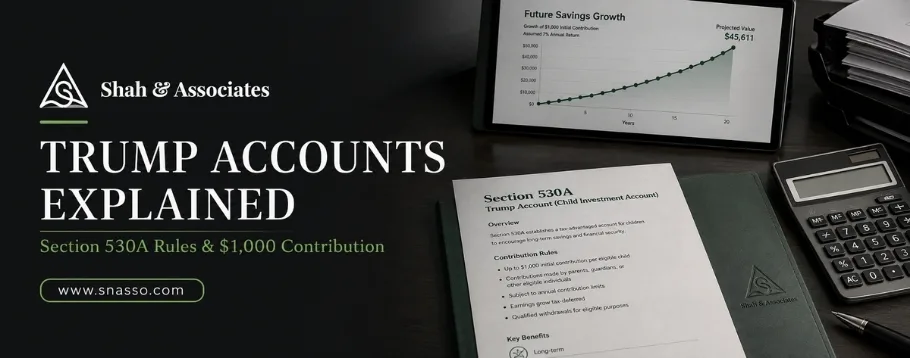
If $1,000 were invested for 60 years and earned an average hypothetical annual return of 7%, it could grow to roughly $58,000, even without another contribution.
That is only an illustration. Actual returns will vary, markets can decline, investment costs matter, and no return is guaranteed.
Now imagine regular contributions continuing throughout childhood and adulthood.
The combination of:
- Starting early
- Consistent contributions
- Long-term investing
- Compounding
- Low-cost diversified funds
could potentially make early childhood investment accounts meaningful components of long-term family financial planning.

How to Open a Trump Account
The IRS currently provides an election process through Form 4547, Trump Account Election(s) and its online systems.
Families should generally be prepared with information including:
- The child’s Social Security number
- Date of birth
- Address
- Parent/guardian or authorized individual’s required information
Qualifying families can also make the election relating to the federal $1,000 pilot program contribution.
Trump Accounts became fundable beginning July 4, 2026.
Because the program is new and Treasury and IRS continue issuing regulations and operational guidance, taxpayers should review the most current IRS instructions before acting.
Trump Account Tax Planning Considerations for Families
Although opening the account may be relatively straightforward, families should consider how it fits into the rest of their financial picture.
Important questions can include:
1. Should You Max Out the $5,000 Limit?
Not necessarily.
Families should consider emergency savings, retirement funding, high-interest debt, college goals, insurance needs, and household cash flow before committing money to an account with significant childhood withdrawal restrictions.
2. Should You Fund a Trump Account or 529 First?
That depends heavily on whether your primary goal is:
- College education,
- Long-term wealth,
- Retirement,
- Flexibility, or
- A combination of these objectives.
3. Does Your Employer Offer Trump Account Contributions?
Employees with eligible children should review workplace benefits because employer contributions may significantly change the economics of funding the account.
4. Are You Tracking Contribution Sources?
Proper recordkeeping may become important when determining basis and taxable distributions later.
5. Are Grandparents or Other Family Members Contributing?
Families should coordinate contributions so the applicable annual limit is not accidentally exceeded.
Recent IRS guidance also includes a gift-tax reporting safe harbor for certain qualifying individual contributions, making current tax guidance important when family members contribute.
For households with multiple savings, tax, retirement, and investment priorities, Shah & Associates can help evaluate financial decisions in the context of broader tax planning rather than viewing any one account in isolation.
FAQs
What is a Trump Account?
A Trump Account is a special type of traditional IRA established under Section 530A for eligible children. During childhood, special contribution, investment, and withdrawal rules apply. Most traditional IRA rules generally begin applying after the account’s growth period ends.
Who qualifies for the $1,000 Trump Account payment?
Under the federal pilot program, qualifying children generally must be U.S. citizens born between January 1, 2025 and December 31, 2028, have valid Social Security numbers, meet other eligibility requirements, and have the required election made on their behalf.
Does every baby automatically get $1,000?
No. An authorized individual must make the required election for an eligible child. Families should not assume the Treasury will automatically deposit $1,000 merely because a child was born during the qualifying period.
Can older kids get a Trump Account?
Yes, qualifying minors who were born before 2025 can potentially have Trump Accounts established if the applicable requirements are satisfied. However, they generally do not qualify for the special $1,000 pilot contribution reserved for qualifying children born from 2025 through 2028.
Does a child need a job to have a Trump Account?
No. During the Trump Account growth period, contributions can generally be made without the child having taxable compensation. This differs from standard IRA contribution requirements.
How much can parents contribute to a Trump Account?
Contributions subject to the normal growth-period limit are generally capped at an aggregate $5,000 per year, with inflation adjustments scheduled after 2027. The limit considers applicable contributions from multiple sources rather than providing a separate $5,000 limit to every donor.
Does the $1,000 government contribution count toward the $5,000 limit?
No. The qualifying Treasury $1,000 pilot contribution is generally outside the $5,000 annual contribution limit.
How much can an employer contribute?
A qualifying employer Trump Account contribution program may generally provide up to $2,500 per employee annually, subject to applicable rules. Employer contributions generally count toward the overall $5,000 annual limit.
What happens if you miss a year of Trump Account contributions?
There is generally no requirement that parents contribute every year. If you contribute nothing in one year, the account can remain invested. However, unused annual contribution capacity generally should not be assumed to carry forward into a later year. Families should evaluate contribution limits based on the rules applicable to each year.
Can you lose money in a Trump Account?
Yes. Trump Accounts invest in eligible market-based investments such as qualifying index mutual funds and ETFs. Stock markets can rise or fall, so account values are not guaranteed.
Can Trump Account money be withdrawn before age 18?
Generally, ordinary distributions are restricted throughout the growth period. Limited exceptions apply for specific circumstances such as qualifying rollovers, excess-contribution corrections, certain ABLE rollovers, or the beneficiary’s death.
What happens when the child turns 18?
Beginning January 1 of the calendar year the beneficiary turns 18, most special Trump Account growth-period restrictions end and rules similar to those applicable to traditional IRAs generally apply.
Can a Trump Account be used for college?
After the growth period, qualified higher education expenses can potentially qualify for an exception from the 10% IRA early-distribution tax. However, taxable portions of the withdrawal may still be subject to regular income tax.
Can Trump Account money be used for a first home?
Traditional IRA first-time homebuyer rules generally apply after the growth period. Current IRA rules include an exception from the 10% additional tax for up to $10,000 of qualifying first-time homebuyer distributions, subject to applicable requirements.
Is a Trump Account better than a 529 plan?
They serve different purposes. A 529 plan is primarily designed for education and can provide tax-free qualified education distributions. A Trump Account is designed more broadly around early investment and long-term wealth accumulation, eventually operating largely under traditional IRA rules. Some families may benefit from using both.
Final Thoughts: Should Parents Open a Trump Account?
Trump Accounts represent a significant new option in children’s financial planning.
For qualifying children born between January 1, 2025 and December 31, 2028, the potential $1,000 Treasury contribution gives families an immediate reason to review the program.
But the account’s potential value extends beyond that initial contribution.
The ability to:
- Start investing during childhood without requiring the child to have earned income;
- Receive contributions from family and other permitted sources;
- Potentially receive employer contributions;
- Invest in diversified U.S. index-based funds; and
- Keep funds invested over a potentially very long horizon
makes the Section 530A Trump Account worth considering as part of a broader long-term financial strategy.
At the same time, a Trump Account should not automatically replace an emergency fund, parents’ retirement savings, a 529 education plan, or other financial priorities.
The right strategy depends on the family’s income, tax position, education plans, employer benefits, cash-flow needs, retirement goals, and expected contribution levels.
Because this is a new federal tax and investment program, additional Treasury and IRS guidance may continue to refine administrative and tax rules.
Shah & Associates helps individuals and families understand changing tax rules and make financial decisions with greater clarity. If you are evaluating Trump Accounts alongside college savings, retirement planning, tax strategies, or other family financial goals, professional guidance can help you understand how the different options fit together.
Disclaimer : This article is for general informational purposes only and does not constitute tax, legal, or investment advice. Tax laws, regulations, and IRS guidance may change. Consult an appropriate tax or financial professional regarding your specific circumstances.