
Table of Contents
- Introduction – Why Quarterly Estimated Taxes Matter for Your Business
- Who Needs to Pay Quarterly Estimated Taxes in PA & NY
- Quarterly Estimated Tax Due Dates in 2025
- How to Calculate Your Quarterly Estimated Taxes
- Avoiding Penalties and Underpayment Issues
- How Shah & Associates Helps Small Businesses Stay Compliant
- Conclusion
Introduction – Why Quarterly Estimated Taxes Matter for Your Business
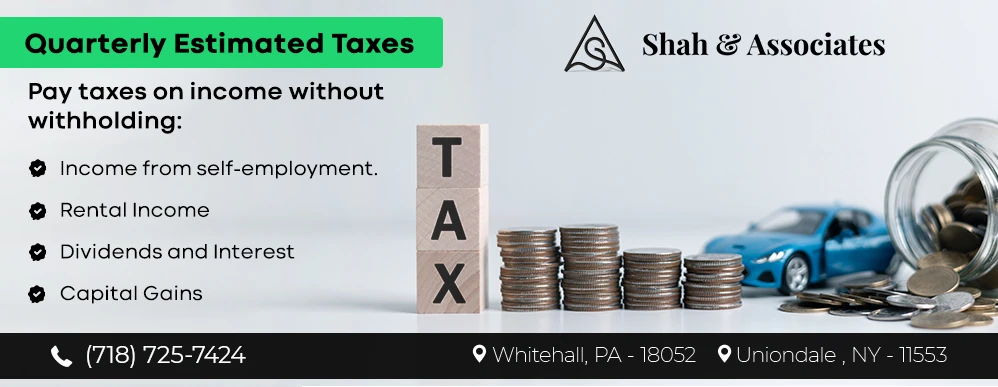
Quarterly estimated taxes are payments made throughout the year for income that is not subject to regular deductions. This usually includes:
- Income from self-employment.
- Rental Income
- Dividends and Interest
- Capital Gains
For example if you owe at least $1000 as taxes, when you file your annual return. Then you are required to pay estimated taxes quarterly throughout the year.
Consequences of missing payments: It can lead to penalties and interest from both the IRS and your state tax department.
Who Needs to Pay Quarterly Estimated Taxes in PA & NYC
1. Federal IRS guidelines for small businesses
At the federal level, you must submit quarterly anticipated tax payments to the IRS:
- If your expected paying is $1000 or more in federal income tax for the year after subtracting any deductions and refundable credits.
- If your expected deductions and credits are less than:
- 90% of your current year’s tax or
- 100% of the tax mentioned on your previous year’s return
2. State-specific rules for PA
You may be required to pay quarterly estimated tax PA, if:
- You expect to owe more than $1,000 in PA personal income tax for the year after subtracting any deductions or credits.
- You receive income not subject to withholding, such as:
- Self-employment income
- Rental income
- Interest and dividends
- Capital gains
3. State-specific rules for NY
You may be required to pay quarterly estimated tax NY, if:
- You expect to owe at least $300 in New York State income tax after subtracting any deductions and credits.
- You had a New York State tax liability of $300 or more in the prior tax year
- You receive income not subject to withholding, such as:
- Self-employment income
- Rental income
- Interest and dividends
- Capital gains
Quarterly Estimated Tax Due Dates in 2025
Below given table is showing IRS estimated tax due dates:
| Payment Period | Due Date | Federal | Pennsylvania (PA) | New York (NY) |
|---|---|---|---|---|
| January 1 – March 31 | April 15, 2025 | Applicable | Applicable | Applicable |
| April 1 – May 31 | June 16, 2025 | Applicable | Applicable | Applicable |
| June 1 – August 31 | September 15, 2025 | Applicable | Applicable | Applicable |
| September 1 – December 31 | January 15, 2026 | Applicable | Applicable | Applicable |
How to Calculate Your Quarterly Estimated Taxes
It is very important to pay the right amount of estimated tax on each quarter to avoid IRS penalties for small business.
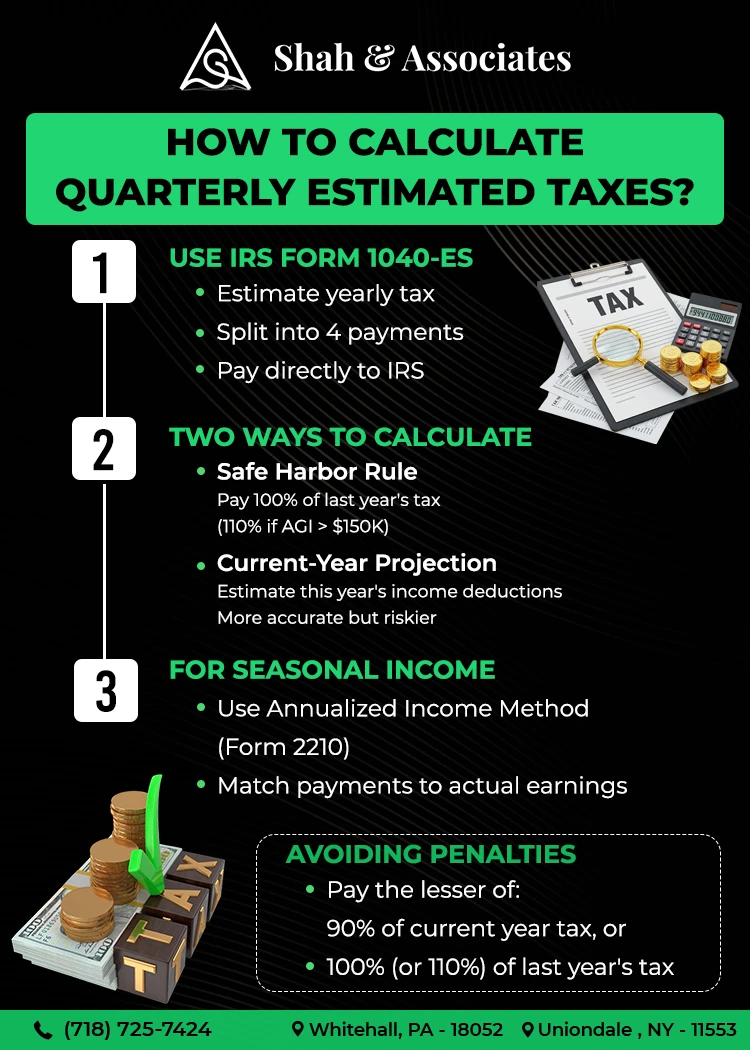
1. IRS Form 1040-ES:
Use Form 1040-ES which is used to
- Estimate your total tax for the year
- Calculate each quarterly payment.
- Submit payments to the IRS
2. Using prior-year tax liability vs. current-year projection
- Use Prior-Year Tax Liability (Safe Harbor Rule): If your prior year’s return was filed and you owed tax:
- Pay 100% of last year’s tax liability, split into 4 equal payments.
- If your AGI was over $150,000 ($75,000 if married filing separately), pay 110% instead.
- Use Current-Year Income Projection: Estimate your actual income, deductions, credits, and taxes for the current year:
- More accurate, but higher risk of underpayment penalties if miscalculated
- Useful if your income fluctuates significantly
3. Considerations for seasonal businesses
- Use the Annualized Income Installment Method (Schedule AI on Form 2210) to match payments with income flow.
- Helps avoid penalties by adjusting payments to when income is actually earned.
Avoiding Penalties and Underpayment Issues
Safe harbor rules:
The Safe Harbor rule helps you to avoid penalties. It says, pay the lesser of
- 90% of your current year’s tax liability, or
- 100% of last year’s tax liability (if AGI ≤ $150,000),
- 110% of last year’s tax liability (if AGI > $150,000).
To avoid penalties.
Adjusting payments mid-year
Adjust your payments mid-year if your income fluctuates. Here are some tips for Mid-year adjustments:
- Recalculate estimates quarterly
- If you underpaid in earlier quarters, you can catch up in Q3 or Q4
- Use IRS Form 2210 to explain changes and reduce penalties.
How Shah & Associates CPA Helps Small Businesses Stay Compliant
Benefits of working with a local CPA in PA & NY:
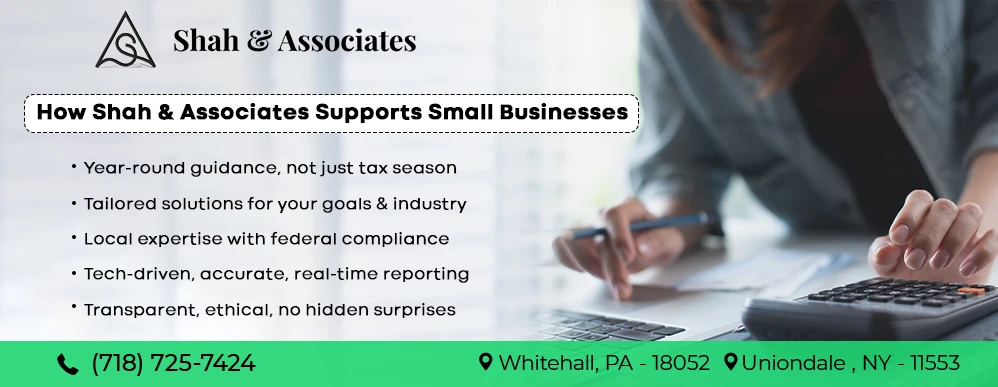
1. Year-round financial guidance: We don’t just wait for tax season. Our staff is available all year to help your changing financial demands through proactive planning.
2. Personalized solutions: We provide personalized solutions depending on your objectives, industry, and financial situation.
3. Local expertise and national reach: Our experts understand both local and federal compliance.
4. Modern accounting solutions: We use advanced technologies and software to provide you with accurate, efficient, and real-time reports.
5. Transparent and Ethical Service: We believe in doing business the correct way. There are no hidden surprises, always clear communication with complete transparency.
Conclusion
Are you ready to simplify your taxes? Let Shah & Associates CPA handle all your small business tax payments, reduce your tax stress and focus on growing your business. Contact us at +1 (718) 725-7424 for all your accounting solutions and expert guidance.