
Table of Contents
Introduction
Running a small business in NYC or PA comes with many responsibilities-from managing daily operations to hiring, marketing, and serving clients. But one of the most critical areas many owners overlook is understanding financial statements.
Your balance sheet, income statement, and cash flow statement are not just accounting paperwork; they are the foundation for decision-making, growth, and long-term stability. When you learn to read these reports like a CFO, you gain clarity about where your business stands today-and where it can go tomorrow.
Why Financial Statements Matter
Financial statements help you answer the big questions:
- Is my business profitable?
- Do I have enough cash to cover upcoming expenses?
- Am I building long-term financial strength-or falling behind on debt?
- Can I confidently approach lenders, investors, or new partners?
Without this knowledge, decisions are based on guesswork. With it, you can plan strategically, control costs, and make informed choices about expansion, hiring, and investment.
The Three Core Financial Statements Every Owner Should Know
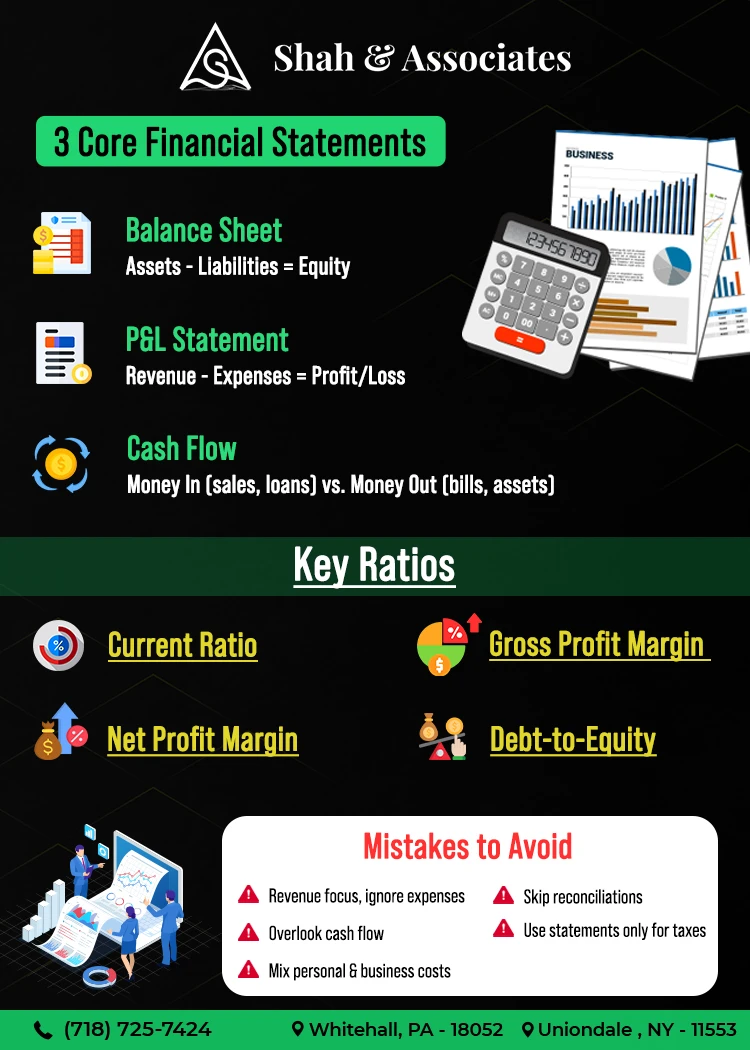
1. Balance Sheet – A Snapshot of Financial Health
The balance sheet provides a clear picture of your business’s financial position at a single point in time. It shows:
- Assets – What you own (cash, inventory, receivables, property, equipment).
- Liabilities – What you owe (loans, vendor payables, payroll taxes).
- Equity – The owner’s residual interest after liabilities are subtracted.
Formula: Assets = Liabilities + Equity
CFOs and investors use the balance sheet to assess financial stability. For example, too much short-term debt compared to assets can signal cash flow pressure. A strong balance sheet, on the other hand, demonstrates resilience and credibility.
2. Income Statement (Profit & Loss) – Measuring Performance
The income statement tracks revenues and expenses over a set period (monthly, quarterly, annually) and reveals whether your business is profitable.
- Revenue – Total income from sales or services.
- Expenses – Operating costs such as rent, payroll, supplies, and marketing.
- Net Income (or Loss) – What remains after expenses are subtracted from revenue.
This is where you measure performance. For example, steady revenue growth with shrinking margins could mean rising costs are eating away at profitability. A CFO uses this report to identify trends and recommend corrective actions.
3. Cash Flow Statement – The Lifeblood of Business
Even a profitable business can fail if it runs out of cash. The cash flow statement explains how money moves in and out of your company through:
- Operating activities – Day-to-day sales and expenses.
- Investing activities – Buying or selling assets.
- Financing activities – Borrowing funds, repaying loans, or equity injections.
Strong cash flow ensures you can cover payroll, pay suppliers, and reinvest in growth. Regular monitoring allows you to spot problems early and avoid liquidity crises.
Key Ratios and Metrics CFOs Monitor
CFOs rely on ratios and metrics to evaluate financial strength:
- Current Ratio = Assets ÷ Liabilities → Indicates short-term solvency.
- Gross Profit Margin = (Revenue – COGS) ÷ Revenue → Shows product profitability.
- Net Profit Margin = Net Income ÷ Revenue → Reflects overall efficiency.
- Debt-to-Equity Ratio = Total Liabilities ÷ Equity → Measures leverage risk.
By tracking these regularly, you can uncover inefficiencies, evaluate growth opportunities, and stay ahead of potential risks.
Common Mistakes Small Business Owners Make
Many business owners unintentionally weaken their financial position by:
1. Looking only at revenue without analyzing expenses.
2. Ignoring cash flow until bills pile up.
3. Mixing business and personal expenses.
4. Skipping monthly reconciliations of bank accounts.
5. Treating financial statements solely as tax documents.
A CFO sees financial reporting as a strategic tool, not a compliance chore. When you adopt the same mindset, you take control of your financial future.
How to Review Financials Like a CFO
- Conduct monthly reviews – Don’t wait until year-end.
- Compare results to budget – Spot variances and investigate the causes.
- Ask deeper questions – Why are expenses rising? Why is revenue slowing?
- Leverage professional insight – CPAs provide context beyond raw numbers.
This approach allows you to identify issues early and act decisively-just like a CFO would.
Beyond the Numbers: Why Professional Guidance Matters
Understanding financial statements is crucial, but interpreting them effectively requires expertise. That’s where professional CPA firms provide value.
At Shah & Associates CPA, we go beyond bookkeeping. Our team supports small business owners in NYC and PA with:
- Tax planning services – Minimizing tax liabilities while maximizing savings.
- Accounting & bookkeeping services – Accurate records for compliance and decision-making.
- Payroll setup and compliance – Streamlined payroll that keeps you compliant.
- Business advisory / CFO services – Financial strategies tailored to your growth goals.
Think of us as your outsourced CFO-helping you not just record numbers, but use them to build a stronger, more profitable business.
Final Thoughts
Learning to read your financial statements like a CFO gives you the tools to make smarter decisions, avoid costly mistakes, and grow with confidence. But you don’t have to master it all on your own.
At Shah & Associates CPA, we specialize in helping small businesses in NYC and PA interpret financial data with clarity. From cash flow management to profitability analysis, we ensure your numbers tell a story you can act on.
Ready to take control of your financial future? Contact Shah & Associates CPA today and let us help you turn financial data into confident business growth.
FAQs
Why should small business owners understand financial statements?
What is the difference between income and cash flow statements?
How often should I review my finances?
Can a CPA help interpret my statements?
What services does Shah & Associates CPA offer?
Disclaimer: This article is for informational purposes only and should not be considered tax, legal, or financial advice. Tax laws and regulations may change, and individual circumstances vary. Please consult with a qualified CPA or tax advisor before making decisions regarding your specific tax situation.