
Table of Contents
- Introduction – Why Strategic Tax Planning Is Essential for Small Businesses
- Strategy 1: Choose the Right Business Structure for Tax Efficiency
- Strategy 2: Maximize Deductions with Section 179 and Bonus Depreciation
- Strategy 3: Set Up a Retirement Plan for Owners and Employees
- Strategy 4: Use the Qualified Business Income (QBI) Deduction
- Strategy 5: Leverage Tax Credits for Your Industry and Location
- Putting It All Together – Year-Round Tax Planning
- How Shah & Associates CPA Implements These Strategies for Clients Nationwide
Introduction – Why Strategic Tax Planning Is Essential for Small Businesses
Every dollar counts in the world of small companies. Taxes can soon become one of your most significant expenses, cutting into revenues and restricting development possibilities.That is why strategic tax planning is required.
You may retain more of your hard-earned money in the company by taking proactive steps to lower your tax liability. This not only protects profitability but also improves cash flow. Expert CPA’s like Shah & associates CPA provide tax saving tips for businesses and help in making small business tax strategies to reduce tax burden and increase profitability.
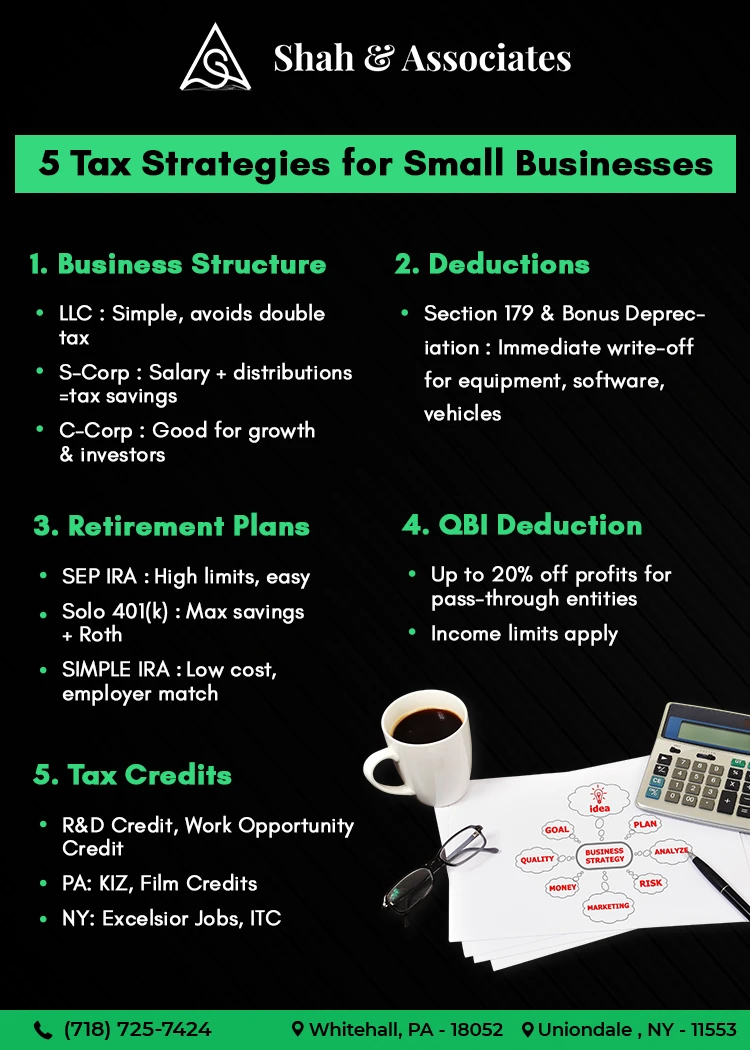
Strategy 1: Choose the Right Business Structure for Tax Efficiency
| Business Structure | Taxation Method | Benefits | Limitation | Suitable for |
|---|---|---|---|---|
| LLC (Limited Liability Company) | Pass-through taxation |
|
Self-employment tax on all profits | Freelancers and small startups |
| S-Corp (S Corporation) | Pass-through taxation + option to pay yourself a “reasonable salary” and take remaining profits as distributions (lower self-employment tax) |
|
Strict IRS requirements and payroll compliance needed | Businesses earning consistent profits |
| C-Corp (C Corporation) | Corporate tax rate + dividends taxed on personal return (double taxation) |
|
Double taxation and more regulations | Larger companies planning to reinvest profits or seek investors |
Strategy 2: Maximize Deductions with Section 179 and Bonus Depreciation
1. Section 179 deduction 2025: It allows businesses to get immediate deduction for business expenses which are related to depreciable assets like equipment and software.
2. Bonus depreciation: It allows you to deduct 100% of the qualifying assets in the first year.
Examples of Eligible Assets:
- Office equipment (Printers, desks, chairs)
- Business vehicles over 6,000 lbs.
- Machinery
- Computers
- Business software
Strategy 3: Set Up a Retirement Plan for Owners and Employees
| Plan | Who It’s for | Contribution limits | Plan Benefits | Plan Limitations |
|---|---|---|---|---|
| SEP IRA |
|
Up to 25% of compensation (max $69,000) |
|
Employer-only contributions, must contribute equally for all eligible employees |
| Solo 401(k) | Self-employed with no employees (or spouse only) | Employee deferral up to $23,000 + employer contribution (combined max $69,000) |
|
More paperwork and must file IRS Form 5500 once assets exceed $250,000 |
| SIMPLE IRA | Small businesses with ≤100 employees | Employee deferral up to $16,000 + 3% employer match |
|
Lower limits than SEP/Solo 401(k) and Less flexibility |
Strategy 4: Use the Qualified Business Income (QBI) Deduction
It allows eligible business owners to deduct,
- up to 20% of their QBI, plus
- 20 percent of qualified real estate investment trust (REIT) dividends
Who Qualifies?
1. Eligible Entities:
- Sole proprietors
- Partnerships
- S-Corps, and
- LLCs taxed as pass-through entities.
2. Income Limits (2s25):
a. Single filers: Full deduction if taxable income ≤ $191,950
b. Married filing jointly: Full deduction if taxable income ≤ $383,900.
Calculation Basics:
1. Start with net qualified business income which is profit minus allowable expenses.
2. Multiply this by 20%.
3. Compare it against the overall taxable income limit
- If below the limit- full 20% deduction
- If above the limit- Deduction limited to the greater of:
- 50% of W-2 wages, or
- 25% of W-2 wages + 2.5% of qualified property.
Strategy 5: Leverage Tax Credits for Your Industry and Location
1. R&D credit: It recognizes those businesses who innovate or improve products, processes, or software, regardless of whether they are tech companies.
2. Work Opportunity Tax Credit: It offers up to $2,400-$9,600 per hire for hiring people from specific groups (veterans, long-term jobless, etc.)
3. State-specific credits
Pennsylvania:
- Keystone Innovation Zone (KIZ) Tax Credit – For technology-based startups in specific zones.
- Film Production Tax Credit – For Pennsylvania firms who work on film or media projects.
New York:
- Excelsior Jobs Program – For firms looking to create new jobs in high-tech, biotech, and manufacturing industries.
- Investment Tax Credit (ITC) – For investments in production or manufacturing equipment.
Putting It All Together – Year-Round Tax Planning
1. Avoid last-minute tax planning mistakes
- Waiting till tax season to analyze financials
- Failing to track spending consistently.
- Ignoring tax credits or deductions because of inadequate recordkeeping
2. Benefits of quarterly reviews with a CPA
When you work with Expert CPA like Shah & associates, it will provide you numerous benefits like:
- Avoids errors, audits and delays
- We plan tax- saving strategies
- We can detect deductions, credits, and structural changes in real time.
- One on one guidance which is personalized to your goals.
How Shah & Associates CPA Implements These Strategies for Clients Nationwide
1. We assist clients in selecting the most tax-efficient structure and managing the paperwork to assure compliance.
2. We assist organizations in maximizing Section 179 and Bonus Depreciation benefits.
3. We help owners get the most out of their retirement accounts, from setting up Solo 401(k)s to negotiating QBI deduction complexity.
4. We have expertise in state tax credits like
- Pennsylvania specializes in KIZ credits, manufacturing incentives, and local tax relief schemes.
- New York: Excelsior Jobs Program credits and Investment Tax Credits.
Disclaimer: The information provided in this blog is for general educational and informational purposes only. It should not be considered tax, legal, or financial advice. Tax laws and regulations may change, and their application can vary based on your individual circumstances. For advice related to your specific situation, please consult with a qualified CPA, tax advisor, or financial professional before making any decisions.